Refined · Balanced · Natural
Harmony Begins in the Upper Face
Bespoke surgical solutions for a more balanced and refined forehead.
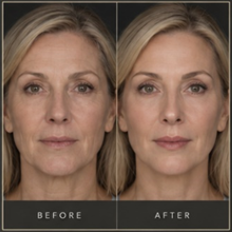
The forehead has a major influence on facial proportion and the appearance of the upper face. Its height, contour, bony projection, hairline and soft-tissue position all contribute to whether the face appears balanced and harmonious.
Forehead surgery is therefore not one single operation. Depending upon the individual anatomy and concern, treatment may involve altering the hairline, underlying forehead skeleton, forehead contour or position and support of the forehead and temporal tissues.
Mr Mattine assesses the forehead in relation to the hairline, temples, eyebrows, eyes and facial skeleton, creating an individual surgical plan rather than treating one feature in isolation.
Hairline Lowering /
Forehead Shortening
Tailored solutions
for your anatomy
Frontoplasty /
Brow Bone Reduction
A smoother,
more refined contour
Forehead
Contouring
Enhancing balance
and definition
Forehead
Lift Surgery
Rejuvenating the
upper face
Temporal /
Temple Lift Surgery
Restoring support
and harmony
The objective is not simply to produce a smaller forehead, flatter bone or tighter skin.
It is to create a more harmonious relationship between the hairline, forehead, temples and eyes while preserving the individual character of the face.
Better proportion.
Refined contour.
Restored support.
Natural facial harmony.
Improving Forehead-to-Face Proportion
Hairline lowering, also known as forehead reduction or forehead shortening, reduces the vertical height of the forehead by advancing the hair-bearing scalp forward.
A naturally high hairline or disproportionately long forehead can make the upper third of the face appear dominant. Lowering and carefully reshaping the hairline can improve the relationship between the forehead, eyes and remainder of the face.
“A more balanced,
harmonious proportion.”

Who May Benefit?
Suitability depends upon scalp laxity, hair density, hairline design and the likelihood of future hair loss.

Benefits
Hairline lowering can:
“A natural hairline that belongs with your face.”

The Procedure
An incision is carefully positioned along the natural hairline. The scalp is mobilised and advanced forward, allowing the hairline to be repositioned.
The degree of lowering possible varies between patients and is determined primarily by scalp laxity and individual anatomy.
The objective is not simply to create a lower hairline, but a natural hairline position and contour that belongs with the rest of the face.

At a Glance
PROCEDURE TIME
Typically 1–2 hours
ANAESTHESIA
General or sedation
HOSPITAL STAY
Day case
RECOVERY
Most patients resume normal activities within 1–2 weeks
REFINING A PROMINENT BROW RIDGE
Frontoplasty involves reshaping the frontal bone and the bony prominence immediately above the eyes.
Some patients naturally have a strong or prominent brow ridge that can make the upper face appear heavy or overly projected. In other patients, there may be asymmetry or disproportion between the forehead and the remainder of the facial skeleton.
Careful reduction and reshaping can soften this area and improve the relationship between the forehead, eyes and surrounding facial skeleton.
“A smoother, more refined upper facial contour.”
Who May Benefit?
Benefits
The Procedure
The technique is determined by the thickness and shape of the bone and, importantly, the anatomy of the underlying frontal sinus.
The brow bone may be carefully reduced, reshaped or reconstructed to create a smoother contour while maintaining the structural integrity of the forehead.
The objective is refinement and facial balance rather than excessive reduction.
REFINED CARE. NATURAL FACIAL HARMONY.
CORRECTING IRREGULARITIES OF THE FOREHEAD
Not every forehead concern relates to overall size or brow prominence.
Some patients have localised bony lumps, osteomas, asymmetry, excessive convexity, areas of flatness or contour irregularities that disrupt the smooth appearance of the forehead.
Forehead contouring is designed to address these individual abnormalities.


The treatment depends upon the underlying problem.
Prominent areas may be reduced or reshaped, while deficient or flat areas can, in selected patients, be augmented using appropriate implants, bone substitutes or onlay materials.
This allows the forehead to be treated three-dimensionally rather than simply reduced.

The objective is a smooth and naturally balanced forehead contour that flows harmoniously into the temples and upper facial skeleton.
ADDRESSING HEAVINESS, LAXITY AND FOREHEAD WRINKLING
Aging of the forehead is not simply a question of brow position.
Some patients develop a heavy forehead, increasing skin and soft-tissue laxity, prominent horizontal forehead lines or excessive activity of the frontalis muscle. These changes can make the upper face appear heavier, more tired and less defined.
Forehead lift surgery is designed to reposition and support the forehead tissues and improve these age-related changes.
In appropriate patients, lifting the forehead may also improve the position of the eyebrows indirectly, but specific brow lifting and brow-shape surgery are considered separately.
“A smoother, more youthful and naturally refreshed upper face.”
Who May Benefit?
Forehead lift surgery may be considered in patients who have:
The procedure is planned according to the patient’s forehead anatomy, skin and soft-tissue quality, hairline, degree of laxity and pattern of ageing.
Direct or Endoscopic
Forehead lifting can be performed using different surgical approaches.
A direct forehead lift provides direct access to the forehead tissues and can allow substantial repositioning where this is required.
An endoscopic forehead lift is performed through small incisions concealed within the hair-bearing scalp. Using an endoscope and specialised instruments, the forehead tissues can be released and repositioned through these access points.
Neither technique is universally preferable. The appropriate approach depends upon the individual patient’s anatomy, forehead height, hairline, degree of laxity and the amount and direction of correction required.
The Aim
The objective is not simply to tighten the forehead.
It is to produce a smoother, better-supported and more youthful forehead while preserving natural movement and avoiding an over-elevated or operated appearance.
NATURAL
RESULTS
AT EVERY STAGE
RESTORING SUPPORT TO THE LATERAL FOREHEAD AND TEMPLE
Aging can also affect the lateral forehead and temporal region.
With time, these tissues may lose support and tone, producing laxity and descent around the outer forehead, temple and lateral eye.
A temporal or temple lift is designed specifically to elevate and support the lateral forehead and temporal tissues, rather than treating the entire forehead.
The temple forms an important transition between the forehead, lateral brow, eye and upper cheek.
Loss of support in this region can contribute to:
Restoring support to this area can create a subtle but aesthetically important improvement to the upper face.
Because the tissues of the temple are anatomically connected to the lateral forehead and brow, temporal lifting may also improve the position and support of the outer aspect of the eyebrow and the tissues around the lateral canthal region.
The objective, however, is not simply to raise the eyebrow. It is to restore tone, support and contour to the lateral upper face.
This can be particularly aesthetically pleasing in appropriately selected patients, including women seeking a refined and slightly more elevated appearance to the outer eye and temple.
The aim is a natural elevation and restoration of support, rather than an exaggerated or excessively pulled appearance.
Careful treatment of the temporal region can improve the relationship between the forehead, temple, lateral brow and eye, while maintaining the patient’s individual facial character.
Mr Matine is internationally recognised for his expertise in facial surgery and for his contribution to the advancement of surgical techniques and education.
He is regularly invited to lecture, deliver keynote presentations and teach live surgery at leading international meetings and conferences, sharing his knowledge and experience with surgeons worldwide.
His international reputation reflects a career devoted not only to achieving exceptional results for his patients, but also to advancing facial surgery through innovation, education and the sharing of expertise.


London Facial Surgery Symposium
European Aesthetic Congress
International Rhinoplasty Society
Global Facial Feminisation Summit
British Association of Facial Surgeons
SEE OUR PATIENT FOREHEAD SURGERY TRANSFORMATIONS
SHORT VIDEOS FEATURING REAL PATIENT RESULTS, SURGICAL INSIGHT AND NATURAL, BALANCED OUTCOMES.

Frequently Asked Questions
Clear answers to common questions about forehead surgery, recovery and planning.
Forehead surgery is not one single operation. It refers to a group of procedures designed to improve the height, contour, projection, soft-tissue support and overall balance of the forehead and upper face.
Depending upon the individual concern, treatment may include hairline lowering, frontoplasty or brow bone reduction, forehead contouring, forehead lifting or temporal lifting.
The appropriate procedure depends upon the patient’s anatomy and what is creating the imbalance.
This depends upon the underlying problem.
A forehead that appears disproportionately long may benefit from hairline lowering, whereas a prominent brow ridge may require frontoplasty. Localised bony irregularities may be treated with forehead contouring, while ageing-related heaviness or laxity may be better addressed with a forehead or temporal lift.
In some patients, more than one procedure may be appropriate.
Hairline lowering, also known as forehead reduction or forehead shortening, reduces the vertical height of the forehead by advancing the hair-bearing scalp forward.
It is most commonly considered in patients with a naturally high hairline or a forehead that appears disproportionately long in relation to the rest of the face.
The aim is to improve forehead-to-face proportion while maintaining a natural hairline shape.
The amount of lowering varies considerably between patients and depends primarily upon scalp laxity, hairline anatomy, hair density, the existing height of the forehead and the amount of safe advancement possible.
As a general guide, the hairline may often be advanced by approximately 1–3 cm, depending upon the individual anatomy and the patient’s preference.
In Mr Mattine’s experience, selected patients with favourable scalp mobility have achieved close to 3 cm of forehead shortening.
The objective is not to lower the hairline by the greatest possible amount, but to achieve a proportion that looks natural and balanced for the individual face.
The incision is normally positioned immediately at or just behind the natural hairline, extending into the hair-bearing scalp.
Careful placement allows the scar to sit at the transition between forehead skin and hair-bearing scalp, and hair follicles frequently grow through or immediately adjacent to the scar as healing progresses.
In most patients, the scar matures very well and can become extremely inconspicuous or barely visible.
Scar quality does, however, vary between individuals and depends upon factors including skin type, healing characteristics and hair density.
Frontoplasty involves reshaping the frontal bone and the prominent brow ridge immediately above the eyes.
It may be considered where the brow bones appear particularly prominent, asymmetric or strongly projected, or where the forehead has a heavier or more masculine contour than the patient would like.
The objective is not excessive reduction, but a smoother and more balanced transition between the forehead and eyes.
Yes.
Forehead surgery is not always simply about removing bone. Depending upon the anatomy, prominent areas may be reduced or reshaped, while areas of deficiency or flattening may occasionally require augmentation.
This allows the forehead to be treated three-dimensionally, rather than simply making it flatter.
View the complete list of questions and answers on the dedicated FAQ page.
Additional treatments that may complement your forehead surgery and enhance upper facial balance and overall facial harmony.
REAL EXPERIENCES. REAL RESULTS.