
Refined · Balanced · Natural
Beyond implants. Beyond standard genioplasty.
A comprehensive, individualised approach to chin surgery, considering bone, soft tissue and facial balance.
INDIVIDUAL APPROACH. NATURAL RESULTS.
Chin surgery is often presented simply as a choice between a chin implant and a conventional sliding genioplasty.
My approach is different.
The chin is a complex three-dimensional structure that influences the proportions of the entire lower face. Its projection, height, width and shape all contribute to facial balance — as does its relationship with the lips, jawline, neck and surrounding soft tissues.
For this reason, successful chin surgery should not begin with the question: ‘Implant or genioplasty?’
It should begin by understanding what is actually wrong with the chin — and what needs to change.
Depending upon your individual anatomy, treatment may involve increasing or reducing projection, altering vertical height, narrowing or widening the chin, correcting asymmetry, reshaping the underlying bone or modifying the soft tissues that cover it.
The objective is not simply to create a larger or smaller chin. It is to create a chin that belongs naturally to your face.
No two chins are the same.
For some patients, the chin is too small or retrusive. For others it may be excessively prominent, too long, too short, too wide, asymmetric or poorly defined.
Sometimes the underlying bone is relatively normal but the soft tissues of the chin are poorly supported or have descended.
Frequently, several of these features coexist.
My approach is therefore based upon detailed assessment of the entire lower face, rather than treating the chin as an isolated structure.
This includes consideration of:
The surgical plan is then individually designed around your anatomy rather than forcing every patient into the same procedure.
A chin can appear deficient for several different reasons. It may genuinely lack forward projection, but it may instead be vertically short, narrow, disproportionately wide, asymmetric or poorly defined.
Similarly, an apparently prominent chin may result from excessive projection, excessive vertical height, or a combination of both.
This distinction matters. Simply advancing a chin that is already vertically short may improve its profile without correcting the underlying proportion of the lower face.
Successful chin surgery therefore requires consideration of the chin in three dimensions:
And increasingly, a fourth component:
SPECIALIST EXPERTISE IN CHIN SURGERY
Chin surgery requires a detailed understanding of facial proportion, skeletal anatomy and soft-tissue balance. Changes in projection, height, width and contour can significantly influence the appearance of the lower face.
Mr Samuel Mattine has extensive experience in primary and revision chin surgery, including complex cases requiring advanced skeletal modification, three-dimensional reshaping and correction of previous surgical outcomes.
His approach is individually planned rather than based on a single standard technique, with surgery tailored to each patient’s anatomy, proportions and aesthetic objectives.
Revision surgery forms an important part of his practice, particularly for patients who have undergone previous genioplasty or implant surgery elsewhere.
Mr Mattine also lectures internationally on aesthetic and reconstructive chin surgery, sharing his experience and surgical approach with colleagues across different parts of the world. Over the course of his practice, he has innovated and pioneered a number of alternative surgical techniques, allowing him to offer a particularly broad range of highly specialised options for complex chin surgery, several of which are distinctive to his practice.
Each procedure is designed to achieve a result that is balanced, proportionate and naturally integrated with the rest of the face.

A broad range of surgical options, including individually adapted and complex skeletal approaches.

Specialist experience in correcting and refining the results of previous chin surgery.

Lecturing and teaching on aesthetic and reconstructive chin surgery to surgeons internationally.
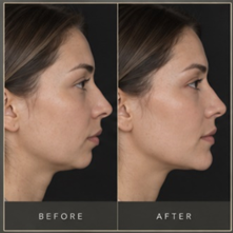
Chin surgery may be considered for concerns affecting projection, height, width, symmetry, soft-tissue support and lower facial balance.
Small or retrusive chin
Excessively prominent chin
Excessively long chin
Wide or broad chin
Narrow or pointed chin
Short lower facial height
Chin asymmetry
Poor relationship between the chin and lower lip
Loss of definition between the chin and neck
Disproportion between the chin and jawline
Deep labiomental fold
Chin ptosis or a drooping chin
‘Witch’s chin’ deformity
In a field where many surgeons divide their practice across the face and body, Mr Samuel Mattine has dedicated his surgical expertise exclusively to the face.
This focused practice provides an in-depth understanding of facial anatomy, proportion and the relationship between the chin and surrounding facial features — essential to achieving a chin surgery result that looks balanced, refined and natural.
INDIVIDUALITY
CREATES
BEAUTIFUL RESULTS
The best chin surgery is not about creating the ‘perfect chin’ — it is about creating the right chin for your face.”
Every chin procedure is individually planned according to your facial anatomy, proportions, skeletal structure and aesthetic goals.
Mr Mattine performs a comprehensive range of chin procedures, adapting the surgical approach to each individual rather than relying on a standardised operation.
Mr Mattine’s expertise extends beyond aesthetic surgery. During his NHS career, he led complex reconstructive facial and microvascular surgery and played an important role in developing advanced head and neck surgical services.
This background provides a depth of anatomical knowledge, surgical judgement and technical precision that continues to inform his approach to chin surgery.
A STRONGER FOUNDATION FOR NATURAL RESULTS
A successful chin procedure should enhance your face — not dominate it.”
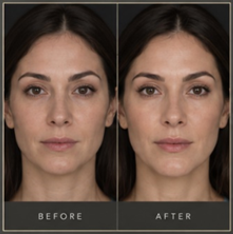
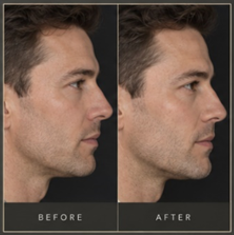
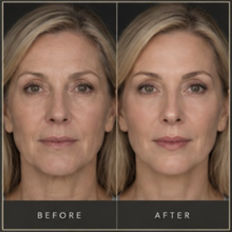
The aim is not to create an artificial or recognisably ‘operated’ chin, but to refine projection, proportion and definition while preserving your individuality.
Every detail is considered in relation to the face as a whole, with the goal of achieving a chin that looks naturally balanced and entirely suited to you.
Mr Samuel Mattine has particular experience in complex chin surgery, including challenging revision cases where previous surgery may have altered the bone, implant position or soft tissues.
These cases often demand meticulous planning, advanced reconstructive techniques and a highly individualised approach, with the aim of restoring support, improving balance and achieving the most natural result possible despite the added complexity of previous surgery.
Chin surgery is one of the most technically and artistically demanding procedures in facial plastic surgery. Choosing your surgeon is therefore about more than choosing a technique — it is about choosing expertise, judgement and an understanding of facial harmony.
Mr Mattine’s approach combines specialist facial surgery, meticulous planning and highly individualised care with one overriding objective:
to create a refined, natural-looking chin that complements your face and remains unmistakably you.
The position, projection and shape of the chin should never be judged in isolation. Its appearance is influenced significantly by the surrounding facial structures — particularly the jawline, neck and nose.
The chin flows directly into the mandibular border and jawline. A well-projected chin can still appear unbalanced if the jawline is narrow, poorly defined or disproportionate. Similarly, changing chin width or projection without considering the mandible can create an unnatural lower-face contour.
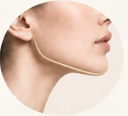
Chin projection has a major influence on how the neck is perceived. A retrusive chin can exaggerate submental fullness and reduce the apparent definition between the chin and neck. Improving projection can strengthen the profile, although genuine fat, muscle laxity or skin excess may require separate treatment.
The apparent size of the chin is closely related to the prominence and projection of the nose. A weak chin can make the nose appear larger, while an overly prominent chin can make the nose appear relatively small. For this reason, profile assessment should consider the relationship between the nose, lips and chin as a single aesthetic unit.
Mr Samuel Mattine has extensive experience with patient-specific PEEK implants, having been one of the first surgeons in the UK to use this technology for facial cosmetic surgery since 2013. Since then, he has used customised PEEK implants extensively to achieve highly precise and natural facial enhancement.
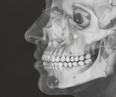
A high-resolution 3D CT scan of your facial skeleton is taken to create a detailed digital model.
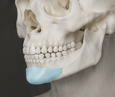
Your implant is designed digitally, allowing precise control of shape, projection and contours to match your anatomy and aesthetic goals.
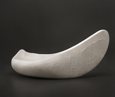
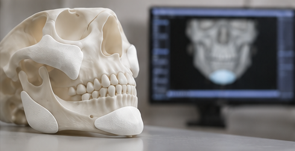
A 3D model of your facial skeleton is printed and your custom implant is manufactured using advanced 3D printing technology.
The implant is precisely matched to your anatomy, allowing accurate and predictable results.
PRECISION
Designed to your exact anatomy for optimal fit and symmetry.
FULLY CUSTOMISED
Complete freedom to create the exact shape and movement to achieve your goals.
ADVANCED 3D TECHNOLOGY
Planned from high-resolution imaging and 3D printed models for exceptional accuracy.
STRONG & STABLE
PEEK is a biocompatible, durable material with long-term stability.
NATURAL RESULTS
Integrates seamlessly with your facial structure for a refined, natural look.
PROVEN EXPERIENCE
Used extensively by Mr Mattine since 2013, with an exceptional track record.
Customised PEEK implants combine advanced imaging, digital planning and 3D printing with surgical expertise, offering a level of precision and individualisation that is not possible with standard implants. This technology allows us to create results that are in harmony with your facial anatomy and your personal aesthetic goals.
INNOVATION · EXPERTISE · NATURAL RESULTS
In selected patients with extreme chin deficiency, a standard sliding genioplasty may not provide enough advancement or projection. Double sliding genioplasty is a highly specialised technique in which two carefully planned bony movements are used within the same operation to achieve a level of advancement that would not otherwise be possible.
This procedure is reserved for rare and carefully selected cases, particularly in patients with severe lower jaw deficiency, previous unsuccessful jaw surgery, or situations in which traditional mandibular osteotomy is not an appropriate option because of poor bone quality or temporomandibular joint abnormality.
It is especially relevant when the patient’s principal concern is aesthetic chin deficiency rather than functional problems with the bite, and when conventional orthognathic surgery would be unsuitable, excessive or unsafe.
MAXIMUM ADVANCEMENT
Allows exceptional projection in the most challenging cases of chin deficiency.
BESPOKE PLANNING
Each movement is individually planned to optimise lower-face balance, shape and proportion.
A RARE EXPERTISE
A highly unusual procedure performed only in very selected cases and a distinctive area of Mr Samuel Mattine’s specialist practice.
NATURAL INTEGRATION
Uses the patient’s own bone to create powerful enhancement with harmonious facial balance.
BEFORE
SEVERE CHIN DEFICIENCY
DOUBLE SLIDING GENIOPLASTY
DUAL BONE MOVEMENTS FOR ENHANCED PROJECTION
Mr Samuel Mattine has developed particular expertise in double sliding genioplasty for extreme cases. To his knowledge, this advanced technique is not routinely offered elsewhere in the UK. In carefully selected patients, it can produce transformative yet balanced improvement when other conventional options are not suitable.
INNOVATION · EXPERTISE · NATURAL RESULTS
AT A GLANCE
A concise guide to what you can expect before, during and after your chin surgery.

1–2 hours

Almost invariably day case; overnight stay available if preferred.

Local anaesthesia, sedation or general anaesthesia, depending on the procedure and patient preference.

Incisions are almost invariably inside the mouth. Very rarely, a small incision beneath the chin may be required.

Expected during the first 1–2 weeks.

Usually 1–2 weeks.

Usually at 2 weeks, 3 months and 1 year.

Based on the type and complexity of your procedure, with a personalised quotation provided after consultation.

Your consultation helps us assess your facial proportions, lower-face balance and aesthetic goals, so we can understand what is important to you.
Our consultation package includes two appointments, with one able to be by secure video if preferred, but at least one face-to-face consultation before surgery.
Our aim is to create a personalized surgical plan and ensure clarity about your options, recovery, risks and what can realistically be achieved.
Facial Assessment
Assessment of your facial proportions, chin position, jawline, neck and profile balance.
Imaging & Simulation
Where appropriate, imaging may help illustrate the intended changes and support your surgical plan.
Your Surgical Plan
A personalised plan designed around your anatomy, aesthetic goals and the surrounding facial structures.
Chin surgery recovery is a gradual process. Careful preparation before surgery, realistic expectations and patience during healing all play an important part in achieving the best possible result.
Every patient heals differently. Swelling, bruising and changes in sensation are normal parts of recovery, and progress can vary from week to week as the tissues settle and the final result gradually emerges.
The guidance provided relates specifically to patients undergoing chin surgery with Mr Mattine, and his team will support you throughout every stage of your recovery.
Your Recovery Mindset
How to set the right expectations and prepare yourself mentally for recovery.
Post-Operative Care
Practical advice to support your healing and achieve the best possible result.
Find answers to the most common questions about chin surgery, including the procedures available, recovery, results and potential risks.
FREQUENTLY ASKED QUESTIONS
Is a chin implant better than a genioplasty?
Will chin surgery change my whole face?
Can you make my chin longer as well as bring it forward?
Can you shorten a long chin?
Can you narrow a wide chin?
Can you correct an asymmetric chin?
Will I have a visible scar?
How long will I be swollen?
When can I return to work?
Will my chin or lower lip be numb?
Request
Appointment
ADDRESS – 1
10 HARLEY STREET
LONDON W1G 9PF
ADDRESS – 2
38 HARBORNE STREET
BIRMINGHAM B15 3HE
REAL EXPERIENCES. REAL RESULTS.